Honorary Doctorate from KU Leuven for Pakistani human rights lawyer
Human rights lawyer Hina Jilani: ‘Our success is that we keep up the fight for human rights’
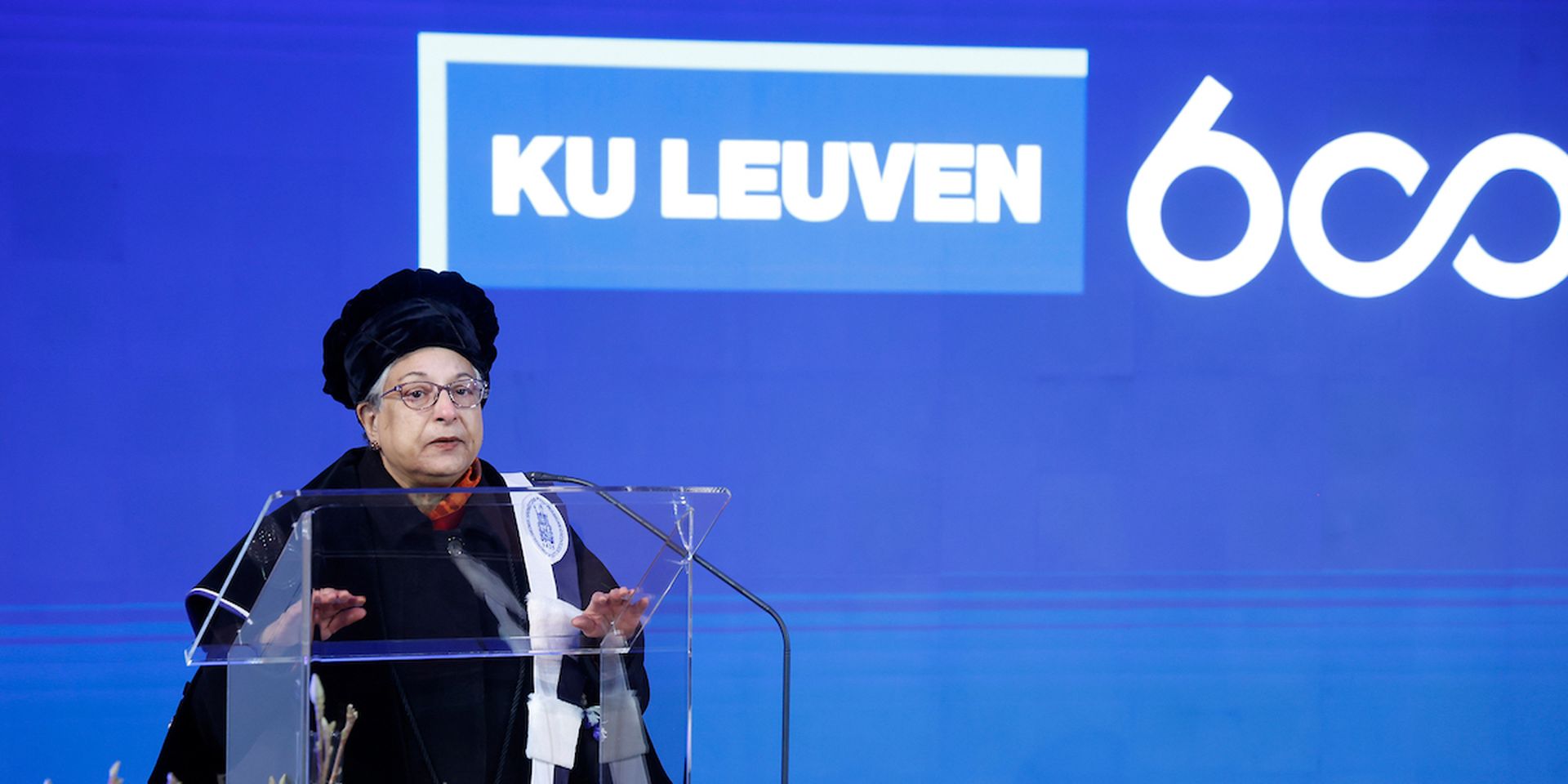
Human rights lawyer Hina Jilani receives an honorary doctorate from KU Leuven.
© KU Leuven
Human rights lawyer Hina Jilani receives an honorary doctorate from KU Leuven.
© KU Leuven

‘I approach genocide and human rights not with emotion, but with a legal perspective,’ says Pakistani human rights lawyer Hina Jilani. Early february she received an honorary doctorate at KU Leuven for her decades of work. MO* spoke to her about human rights, religious politics and Gaza.
This article was translated from Dutch by kompreno, which provides high-quality, distraction-free journalism in five languages. Partner of the European Press Prize, kompreno curates top stories from 30+ sources across 15 European countries. Join here to support independent journalism.
On 30 January, a few days before Hina Jilani receives an honorary doctorate from KULeuven, large-scale violence took place in Pakistan. Armed militants attacked police stations, army posts and a prison in at least nine districts of the western province of Balochistan. At least 33 civilians were killed, 17 policemen or soldiers were killed.
In the military response that followed, 177 militants were reportedly killed, according to the government. In Belgium, newspapers, weekly magazines and TV channels did not cover the attacks or the crackdown.
‘You never even hear anything about Pakistan, even though the country has everything to be constantly in the international spotlight.’ That statement does not only apply to recent events, it was already in a portrait that MO* brought back in 1999 of the then winner of the King Baudouin Prize for Development, Pakistani human rights activist Asma Jahangir.
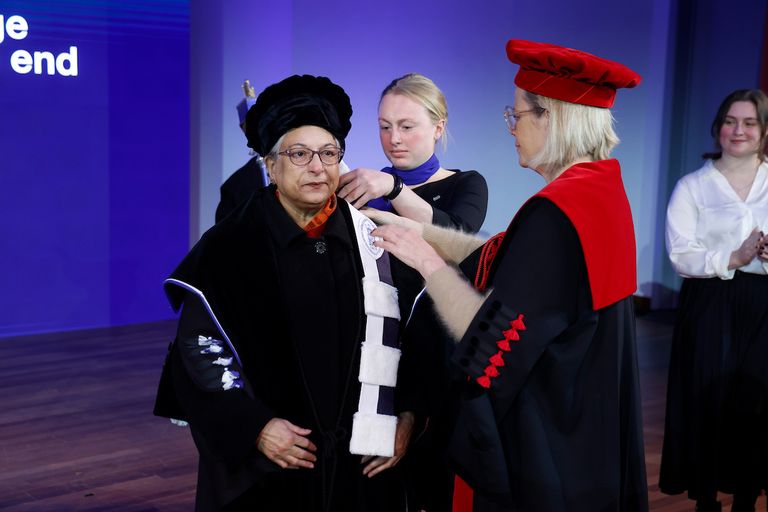
27 years later, her sister, Hina Jilani, received an honorary doctorate from KU Leuven on the recommendation of the student council for her years of commitment to human rights, and in particular women’s rights in Pakistan and worldwide.
Who is Hina Jilani?
Hina Jilani studied law in Lahore. Together with her sister Asma, she founded Pakistan’s first all-female law firm there, followed by the first legal aid office for people of limited means.
The sisters also co-founded the independent Human Rights Commission of Pakistan. Hina also spearheaded Dastak, a shelter that provides free legal advice and support to women fleeing partner violence, child marriage or honour killings.
In 1992, she was appointed a lawyer to the Supreme Court of Pakistan. She co-founded the Women’s Action Forum, which challenges discriminatory laws in the country. Between 2000 and 2008, she was the first Special Representative for Human Rights Defenders at the United Nations.
Since 2013, she has been part of The Elders, a council of world leaders founded by Nelson Mandela that promotes peace and human rights. She is also co-chair of the International Task Force on Justice.
Hina Jilani has received numerous international awards, including the Millennium Peace Prize for Women (2001), the Stockholm Human Rights Award (2020) and Amnesty International’s Genetta Sagan Award (2000). She has also received six honorary doctorates.
‘For me, “political prisoner” was never a vague or abstract concept. It was my father,’ Asma said in the interview I had with her in 1999. Is that family background also the reason you went to law school and campaigned for human rights?
Hina Jilani: ‘Indeed, we saw how our father was arrested and imprisoned for resisting an illegal, military regime and standing up for democracy and basic civil rights. We grew up with the realisation that you cannot remain silent when you see injustice. We learned to speak out, instead of just complaining about the government or society.’
‘My father was an activist and politician at a time when human rights violations were widespread under military dictatorships. He escaped two attacks on his life. But what came after was often even worse. Both Asma and I faced death threats and attacks for a long time. Once, extremists invaded my house and took my family hostage. But in my father’s time, the opposition at least operated collectively and on a level playing field. Today, that opposition is absent, divided and unaccountable. At the same time, the government has completely submitted to the power of the military, which now holds all the strings, even though the government was democratically elected.’
So should human rights defenders turn to the real rulers - the army - or do you continue to address the elected government and the judiciary?
Hina Jilani: ‘The government, of course. As soon as we turn to the military, we give up the fight and resign ourselves to a power structure that goes against the rule of law and human rights. Democratic institutions must be workable and functional, and it is up to us to contribute to that. It is a struggle to keep real power with citizens.’
‘That does not mean there are no positive examples in politics or no attempts to strengthen the rule of law. Both Benazir Bhutto and Nawaz Sharif have tried to make the best of it in the past. As leaders of rival parties, they even signed an agreement promising not to use the army against each other. In the end, everything is about protecting the rule of law.’
Even when governments do their best, you remain a passionate opposition voice.
Hina Jilani: ‘Human rights organisations must always remain vigilant. But we are the voice from outside the walls of parliament. The voice of civil society. The defence of the constitution and fundamental rights should be from within parliament itself.’
Influence of religion
In Pakistan, how does this fight for the rule of law relate to the pressure to subordinate all laws to Sharia law? Since the religious-military dictatorship of Zia ul-Haq, between 1978 and 1988, the Council for Islamic Ideology has been tasked to do exactly that.
Hina Jilani: "That is one of our biggest conflicts. The Council is essentially a useless institution because parliament is not obliged to seek or follow its advice. At the same time, Islamist ideology and the constitution clash. Islamic values are not useful to make or substantiate legal decisions anyway, as they are open to different interpretations by various legal schools and dozens of sects and movements. Fundamental civil rights, on the other hand, are clearly enshrined in the constitution and laws passed by parliament.’
‘There are tensions in that as a whole, because the 1956 constitution also contained concessions to Islamists. As a result, most judges do not use Islamic principles when it comes to rights, but some do, because the space exists for it.’
In a country like Pakistan, should human rights defenders decisively reject religious interference, or should they instead appeal to Islamic scholars who base their support for human rights on the Quran or Sharia?
Hina Jilani: ‘The latter is a futile exercise. We have tried, but then who has the authority and whose interpretation of the Quran, hadith or sharia should we follow? Which of the 70-plus sects? There are several scholars over whom others have issued fatwas.’
‘The rights of women and minorities are guaranteed by the constitution, by legislation and especially by international human rights treaties. We don’t need the Islamic scholars and their disputes among themselves for that. My time and energy are better spent than on such nonsense.’
If political Islam is gaining influence in Pakistan, doesn’t that indicate broad popular support for a more Islamic society?
Hina Jilani: ‘Their power is growing mainly because the state is deploying Islamist groups against opposition movements fighting for democratic freedoms. That extreme current certainly exists, but it hasn’t really penetrated the grassroots. And yes, people pray and value their faith, but that does not necessarily mean they want an Islamic state - even though Pakistan has been one since the 1956 constitution. People do not walk around with the Quran in front of them all the time as they go about their daily lives.’
But the blasphemy law, that remains immutable?
Hina Jilani: ‘That is indeed a big problem because that law is used as a political weapon by the religious lobby. Whoever is in power, whoever tries to touch that law risks his life or his government. When Salman Taseer, the Punjab governor, was assassinated in 2011 for standing up for a woman wrongly accused of blasphemy, no one from the ruling PPP party even dared to come to his funeral.’
There were a lot of lawyers who were only too happy to defend the killer
Hina Jilani: ‘Even among lawyers, you have people with fundamentalist ideas, but they are certainly not the majority. Moreover, recent research has shown that the blasphemy law is often misused to blackmail people. It is also becoming increasingly difficult to win these kinds of cases because everyone is afraid of the religious reaction. Previously, a conviction in a district court was often overturned on appeal before a supreme court. Today, even the supreme court often dares not review such a decision.’
Armed and extremist Islamist organisations have been part of Pakistani society for decades.
Hina Jilani: ‘They are not part of society, they have been created by the state, as sub-contractors of the war against India.’
© KU Leuven
Patriotism
Last weekend’s attacks in Balochistan were presented by the Pakistani government as terrorism allegedly supported and directed by India. As a human rights defender, how do you deal with such a polarised and violent reality?
Hina Jilani: ‘It is true that we work in a violent and polarised environment and therefore have to be extremely careful. I see how complex the situation is. The violence in Balochistan does not stem solely from local people’s frustrations towards the Pakistani state. There is indeed Indian involvement. But what really matters to us is that all attacks on civilians are terrible and unacceptable.’
‘Equally unacceptable are attempts to divide and further politicise the Pakistani army. We have a family history of opposition to military interference in politics, and I continue it with great conviction. But neither do I accept that politics imposes its contradictions on the military. In the politically so sensitive region of South Asia, we simply cannot afford that.’
Being critical of a government in South Asia increasingly creates the risk of being accused of anti-national propaganda.
Hina Jilani: ‘For me, patriotism does not mean the belief that Pakistan is great, but the commitment to make the country better. Whether Pakistan is doing well is measured by how the people are doing; they are the real measure of national greatness or progress. One of our most important missions is to make those citizens more aware of the importance of rights and rule of law, rather than leaving them to the populist forces willing to serve the interests of the military.’
When you say you want to be proud of Pakistan because ...
Hina Jilani: ‘I don’t want to be “proud of Pakistan”, I want to live in a Pakistan where everyone is assured of basic rights.’
Many Pakistanis feel Punjabi, Pashtu, Baloch or Sindhi first. Does that add to the challenge of your work?
Hina Jilani: ‘Those regional identities are less of a problem than the state’s obsession with homogeneous identity. Since 1947, that obsession has pushed state ideology towards Islam as the only shared identity. The drive for one clear, shared identity has blinded Pakistan to the needs of various minorities and even to the demands of the Bengali majority, ultimately leading to the split and formation of Bangladesh. This problem too, by the way, arose in high military circles rather than in the political world.’
Not that the political world is without sins.
Hina Jilani: ‘Certainly not. But for human rights lawyers, it’s not about purity, it’s about rights. That is why I take complaints from parties that sometimes undermine democracy as seriously as other complaints. But “taking seriously” also means: investigating what is true about them. Only then can you effectively confront the government about abuses.
I defend newspapers that attack me because the right to free speech and information is more important. As a lawyer, I have even defended terrorists - the kind of extremists who threatened my life and Asma’s - not because I agreed with their beliefs at all, let alone their methods, but because they have rights that must be respected. The law applies no matter who is accused.’
‘What really counts is the struggle. We don’t always succeed in what we try, but persistence is more important. For me, “success” is not a reward for a case won, but the affirmation that we are continuing our commitment to human rights, democracy and human dignity. As long as we keep up the fight, hope remains alive. Every fight shows the people that the constitution guarantees rights and freedoms, and that there are people committed to them. It reminds the government what it must protect and what it must not violate. We must make it clear that we can indeed do something, even if we do not win every battle or cause.’
Genocide or not?
You want to hold the government to the laws and rights laid down. But not all laws are perfect. For instance, what is the state of women’s legal rights in Pakistan?
Hina Jilani: ‘Women’s rights are invariably improving, often despite and not because of successive governments. Our focus is therefore on society: making it clear why human rights are important for anyone who feels discriminated against or disadvantaged - because often people do not see injustice as a rights issue at all.’
‘Moreover, ordinary people also engage in violence against minorities or women. We want to make it clear to everyone that, for example, rights for women are perfectly defensible in a Muslim country like Pakistan.’
You invested a lot of time fighting for women’s rights.
Hina Jilani: ‘I was first and foremost touched by the issue of gender violence, but it is not just about women and gender. What drives me is the fundamental disregard for rights and human dignity. The denial of the right to dignity and equality.’
Your international human rights work focused on genocide and on Gaza long before all hell broke loose there in 2023. What has that research in Gaza, but also in Sudan’s Darfur, taught you about what has been happening over the past two years?
Hina Jilani: ‘In 2006, I was part of a UN investigation team into the violence in Darfur. Many western governments at the time were keen to hear that there was genocide. The United States made that clear in meetings with the commission. We went on the ground and examined the testimonies, and we did find extreme violence, extermination, massacres and a host of human rights violations.’
‘But we could not confirm genocide, as internationally defined, because a clear intention was lacking. I also stressed this in a conversation with Ban Ki-moon, during the procedure for the appointment of the UN High Representative for Human Rights: I approach such questions not from emotion, but from a legal framework.’
‘Even during the investigation into the Israeli actions against Gaza in 2009, we found no or insufficient evidence to call the violence “genocide”, even though everything necessary for survival seemed to have been destroyed by then. I have been following the current war against Gaza very closely since the very beginning, and I am convinced that this is indeed a case of genocide. Especially now that the US president is enabling and internationally legitimising it all with his so-called Peace Board. Earlier, I was shocked by the lack of outrage over the violence against the Palestinians. Islamic countries also remained silent.’
Pakistan even accepted Trump’s invitation to participate in his “peace board” for Gaza.
Hina Jilani: ‘That is a huge mistake. Pakistan is trying to sweet-talk Trump, but that is a shaky and finite story. The argument is that we can make a difference “from within”, but sooner or later they will realise that it doesn’t work like that. Who will listen to Pakistan? I personally believe much more in the trajectory we are following with The Elders, advocating for the release of Palestinian leaders like Marwan Barghouti, for example.’
 This article was translated from Dutch by kompreno, which provides high-quality, distraction-free journalism in five languages. Partner of the European Press Prize, kompreno curates top stories from 30+ sources across 15 European countries. Join here to support independent journalism.
The translation is AI-assisted. The original article remains the final version. Despite our efforts to ensure accuracy, some nuances of the original text may not be fully reproduced.
Lees meer
If you are proMO*...
Most of our work is published in Dutch, as a proMO* you will receive mainly Dutch content. That said we are constantly working to improve our translated work. You are always welcome to support us both as a proMO* or by supporting us with a donation. Want to know more? Contact us at promo@mo.be.
You help us grow and ensure that we can spread all our stories for free. You receive MO*Magazine and extra editions four times a year.
You are welcome at our events free of charge and have a chance to win free tickets for concerts, films, festivals and exhibitions.
You can enter into a dialogue with our journalists via a separate Facebook group.
Every month you receive a newsletter with a look behind the scenes.
You follow the authors and topics that interest you and you can keep the best articles for later.
Per month
€4,60
Pay monthly through domiciliation.
Meest gekozen
Per year
€60
Pay annually through domiciliation.
For a year
€65
Pay for one year.
Are you already proMO*
Then log in here