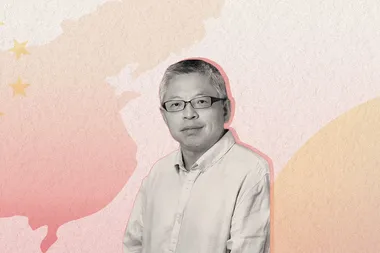
China talks #3: Wang Huiyao
‘Competition is fine, but let’s do it Olympic-style’
)
© MSC – Preiss / Ontwerp: MO*
© MSC – Preiss / Ontwerp: MO*
China could play a much greater role for Europe, for global trade and for peace in Ukraine. That is the firm conviction of Wang Huiyao of the Centre for China and Globalisation, one of China’s best-known think tanks. ‘If you want the war in Ukraine to end, involve China.’
Series: China Talks
The post-war world order is being upended, and China is increasingly positioning itself as an alternative power. Yet, Chinese voices are rarely heard in the mainstream media.
In this interview series, MO* journalist John Vandaele seeks out interesting Chinese professionals and academics willing to share their perspectives with MO*. This is episode 3: What are the secrets behind China’s successful economy? And what role can China play in international politics and trade?
This article was translated from Dutch by kompreno, which provides high-quality, distraction-free journalism in five languages. Partner of the European Press Prize, kompreno curates top stories from 30+ sources across 15 European countries. Join here to support independent journalism.
One of the best-known think tanks in China is the Centre for China and Globalisation, and Wang Huiyao, also known as Henry Wang, is its founder and chairman.
He enrolled at Guangdong University in 1977, the first year that universities reopened following the Cultural Revolution. He studied foreign policy and subsequently worked for the Ministry of Commerce for a time.
Later, Wang Huiyao undertook several courses at Canadian universities, where he also obtained his doctorate. He represented the Canadian province of Québec in China and Hong Kong for a time and worked for several Canadian companies.
He is a member of the Central Committee of the Jiusan Society (formerly the Democracy and Science Forum), one of the eight small political parties permitted by the Chinese Communist Party. Wang also speaks regularly to international media such as the Wall Street Journal and Al Jazeera, and writes opinion pieces for The New York Times and the Financial Times.
We begin our conversation by asking why China has been so successful in the era of globalisation. ‘There are several reasons,’ he replies. ‘China has a history stretching back five thousand years. It invented the meritocracy and the Mandarin system, whereby administrators or civil servants are appointed through examinations rather than via the ballot box. That tradition still exists today. It has a significant impact, because all civil servants are required to perform.’
But leaders such as President Xi Jinping don’t sit any exams, do they?
Wang Huiyao: ‘What I mean is that every year, 20 to 30 million young people sit university entrance exams. In addition, every year 3 million people sit exams for 200,000 civil service posts. If they pass, they start in a post at village level; from there, they can work their way up to a district, a province, or a post in the central administration…’
‘The current top leaders all managed to get into university one way or another and then had to work their way up. How well you deliver a speech, like the Mayor of New York, or how good you are at social media, doesn’t matter. An administrator must deliver results; only then can they be promoted. This performance-based system explains part of China’s success.’
‘A second factor is that China, with its large population, constitutes a huge market. And it was precisely at that moment that it joined the World Trade Organisation (WTO) and was able to use its size to attract foreign investment. That helped lift 800 million people out of poverty.’
‘China has invested heavily in Spain: Spanish Prime Minister Sánchez has visited China three times in the past three years. Chinese companies are investing more than €1 billion there.’
‘Thirdly, China also pursues long-term policies, with its five-year plans (which have built on one another over the last forty years, ed.). Trump announced that he would abolish all of his predecessor Biden’s programmes and laws. You don’t see anything like that in China. There is continuity.’
‘Finally, I would like to quote the former US Ambassador to China, Terry Branstad. In his farewell speech, he attributed China’s success to three things: that the Chinese attach great importance to family and education, and that they work hard, seven days a week, with little time off.’
Foreign friends
Isn’t China so successful that it is undermining globalisation? It has a large trade surplus with many countries. Asia correspondent Robin Harding of the Financial Times recently travelled around China and asked Chinese companies what they still needed from European firms: ‘virtually nothing’. Volkswagen is investing in China because production costs are lower there and is cutting jobs in Germany.
Wang Huiyao: ‘Those are the concerns of our foreign friends. China is the largest trading partner of 140 countries. We provide global public goods: low inflation, affordable, high-quality products…’
‘And whilst the US has withdrawn from the World Health Organisation (WHO), China recently contributed an additional 500 million dollars. We are now the second-largest donor to the United Nations (UN). As China becomes more prosperous, it is taking on greater responsibility.’
‘On the other hand, you do have a point. Whereas China used to make clothes and shoes, it now also produces technologically advanced products such as electric vehicles. And with success.’
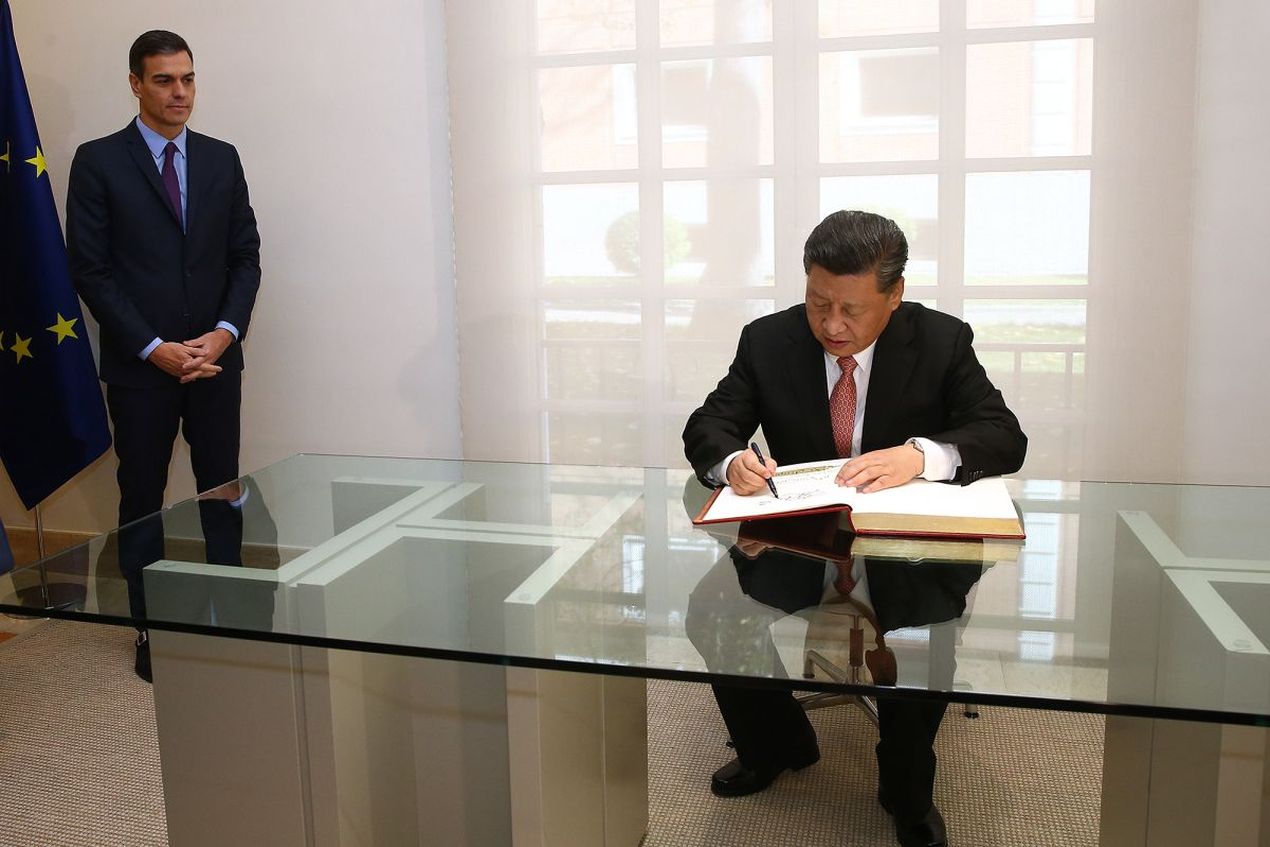
Chinese President Xi Jinping visiting Moncloa—the workplace of Spanish Prime Minister Sánchez (pictured on the left)—in 2018. ‘Sino-European joint ventures can take place not only in China but also in Europe,’ says Wang Huiyao.
© La Moncloa - Gobierno de España (CC BY-NC-ND 2.0)
‘Of course, the European Union still has many strengths, for example in financial services. Even in the electric vehicle sector, European joint ventures are operating successfully in China. But Sino-European joint ventures are also possible in Europe. China has invested heavily in Spain: the Spanish Prime Minister Sánchez has visited China three times in the past three years. Chinese companies are investing more than 1 billion euros there.’
‘Compare it with Japan back then: when the Japanese car industry overtook that of the US, there were also many trade tensions. Japan then began investing heavily in the US, Europe and elsewhere: this created jobs and income in all those countries and was accompanied by a transfer of technology.’
But China is much bigger than Japan.
Wang Huiyao: ‘China now produces between 16 and 17 million electric vehicles, and exports only two to three million of them. Japan produces 10 million cars and exports 8 million. Nobody talks about Japanese overcapacity.’
‘China buys a lot of aircraft from Airbus and Boeing. Would you then say that the EU and the US have overcapacity when it comes to aircraft? We can work out solutions if we have a good relationship. China is keen to invest, globally, and certainly in the US and the EU.’
Learning from Chinese companies
So you’re advocating that Chinese and European companies set up joint ventures together, so that, in addition to job creation, technology transfer also takes place. In this way, Europe can learn from Chinese companies how to manufacture, say, rock-bottom-priced solar panels by 2026. Are Chinese companies willing to do this?
Wang Huiyao: ‘Certainly. There is great interest among Chinese companies in investing all over the world. The first phase involved production in China for the Chinese market. The second phase, following China’s accession to the WTO, was production in China for the world. The third phase will be: Chinese companies producing globally for the world. So China is going global so that production and research can take place anywhere.’
‘That is, of course, provided there are good relations. Why is 40 per cent of Chinese investment in the EU in Hungary? Because we have good relations with them. And Spain is doing well too. I get the impression that other countries are following suit. Recently, the leaders of Canada, France, Germany and the United Kingdom visited Beijing. Those visits help to improve relations.’
Does China want to transfer technology?
Wang Huiyao: ‘China can easily share that if it is granted access to the market.’
Just as American multinationals invested all over Europe after 1945. That went smoothly back then because there was a great deal of trust.
Wang Huiyao: ‘Exactly.’
Doesn’t that require a more balanced trade relationship?
Wang Huiyao: ‘I often hear that concern. China is good at exporting goods, and a lot of attention is focused on China’s trade surplus. But the US has a dollar surplus, and that works. The US stock market is at an all-time high and is attracting investment from all over the world. Even China has bought 1,000 billion dollars’ worth of US Treasury bills.’
‘I don’t think the US is losing out, but they focus on the imbalance in the trade balance and never talk about the financial balance.’
Consuming more
What about the hukou, the household registration system that means hundreds of millions of migrant workers have no social rights in the cities where they work, but only in their home villages? If you change that, you’ll create a great deal of purchasing power for that large group.
Wang Huiyao: ‘You’re right: we should abolish the hukou. So that migrant workers can access schools and healthcare facilities in the cities where they work, rather than in their distant home villages.’
‘Europeans are familiar with Africa. I see the potential for excellent cooperation there: China provides the clean tech, the EU supplies the capital, and Africa benefits.’Wang Huiyao
‘I would even go further and allow the 300 million migrant workers in the cities to sell their property in the countryside, so that they can live in the city. That will create a major new boom for the construction sector and a major new market in general. I’m hoping for that.’
‘China takes such major steps every ten years; this is one of the next ones. We have built the best infrastructure in the world, which has made us more productive. But people are now consuming less because the value of their homes has fallen due to the crisis in the construction sector. The government wants to rectify that.’
A higher exchange rate for the renminbi would also help. It has fallen quietly over recent years.
Wang Huiyao: ‘The renminbi could certainly be revalued slightly. But another way to make our exports more expensive is through import tariffs. If those are scaled back, a revaluation is certainly possible.’
Cooperation with China?
What should happen to the World Trade Organisation? The US is blocking and ignoring it. Can it be reformed?
Wang Huiyao: ‘I think it’s possible. Many countries still want to work with the WTO, so why shouldn’t we continue to do so? If necessary, a “WTO minus one”, without the US. After all, 85 per cent of world trade still takes place under WTO rules.’
You’ve put forward a proposal for global green industrialisation to accelerate the green transition in emerging economies, not least in Africa. You write that this would not be led by China. But if I read your proposal correctly, China has everything it needs to do it alone: cleantech, state-owned banks capable of providing finance… What specific role do you envisage for Europe?
Wang Huiyao: ‘Africa has plenty of sun and wind. China and the EU could jointly build large solar farms in Africa and then construct transmission lines to transport electricity to the EU, or to store it locally. Europe could source some of its energy from Africa instead of relying on Russia.’
‘Europeans are familiar with that region. I see the potential for very good cooperation there: China provides the clean tech, the EU provides the capital, and Africa benefits from it. The electricity can be consumed by both Europe and Africa.’
When I suggested this kind of cooperation to Koen Doens, the senior European official in charge of the Global Gateway, he was reluctant to work with China.
Wang Huiyao: ‘We believe that initiatives such as the New Silk Road or the Global Gateway should dare to seek synergies. France and China have signed an agreement to cooperate in third countries. France and the United Kingdom still have a great deal of influence in Africa. I cannot see why the EU and China cannot cooperate there.’
I sense a degree of reluctance among European leaders.
Wang Huiyao: ‘I think there are two factors at play. The EU countries are part of NATO, which is the US’s sphere of influence. And if the US seeks to rival China, European countries are therefore expected to go along with that. This leads to a great deal of trust being lost. The relationship has really deteriorated, particularly since Russia’s war in Ukraine. We need to restore that trust.’
‘Furthermore, Chinese companies, with their new levels of efficiency and scale, are sometimes perceived as a threat. Let us build trust and welcome those Chinese investments.’
There are many reasons for this mistrust, starting with the very different systems of government. The EU has multi-party systems with elections; China does not – it is a one-party state.
Wang Huiyao: ‘Since the Covid crisis and the second Trump administration, the relationship has already improved; I sense this in my dealings with Europeans. There is a growing realisation that China must have done something right to achieve what it has achieved. There is a certain recognition that there isn’t necessarily just one way or one model. And that, because of our own history, we are following a different path.’
‘Moreover, the Western model of democracy is facing problems. Look at the political paralysis in France. Perhaps the strongest example is Trump, who is simply undoing everything Biden did. China does not want that sort of democracy.’
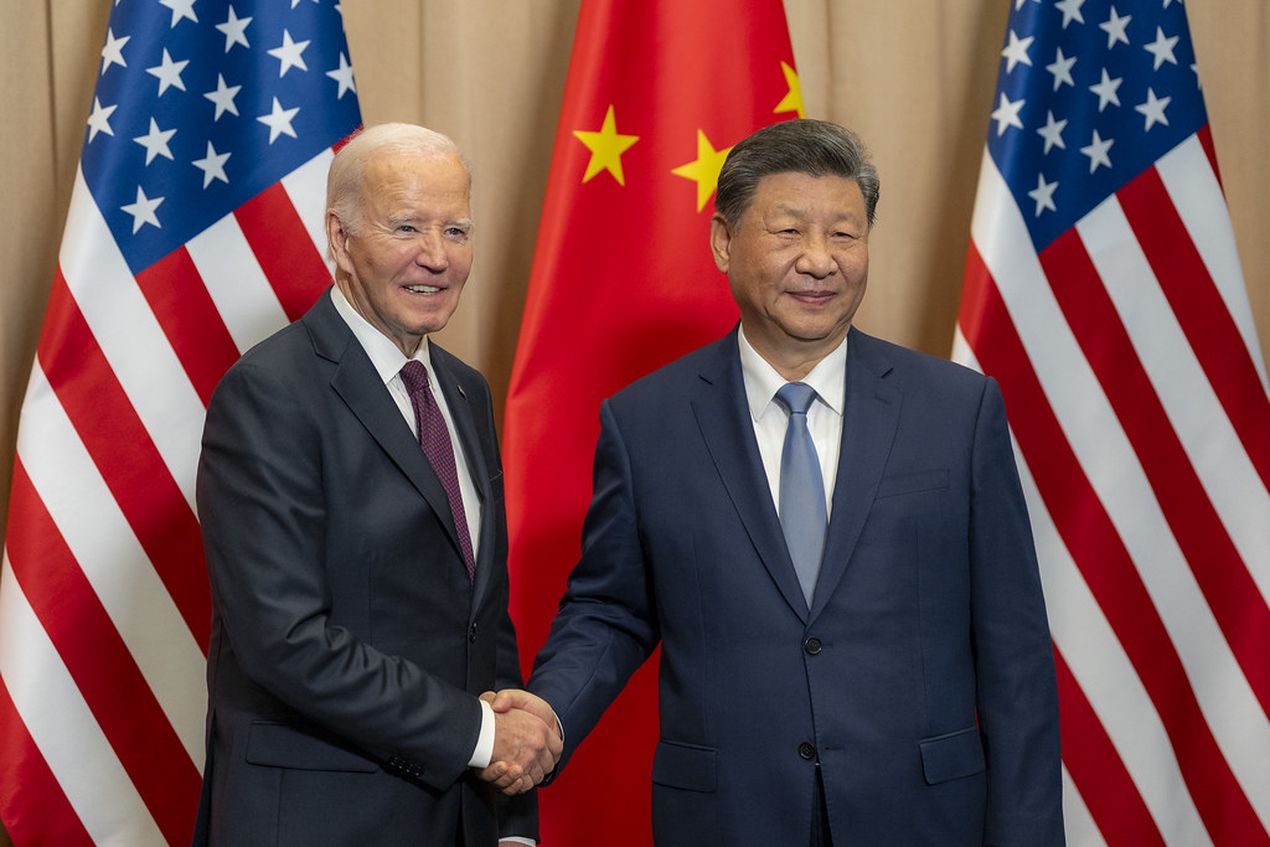
A meeting on the sidelines of a summit in Peru, late 2024. ‘President Biden did not visit China for four years. His senior officials didn’t come often, either. They were mainly focused on accusations, not on real dialogue.’
© Public domain (White House/Adam Schulz)
‘China certainly still has many weaknesses and room for improvement in many areas, but it has maintained its economic growth, lifted 800 million people out of poverty and built the world’s best infrastructure. And it is leading the world in the green energy transition.’
‘You cannot simply deny China the right to develop on the basis of your own ideology. That is why more and more global leaders are coming to China. We must learn to co-exist peacefully. Competition is fine, but let us do it in Olympic style, rather than imposing sanctions, tariffs and unilateral measures.’
No weapons for Russia
Another crucial reason for European mistrust is the war in Ukraine. Isn’t China’s influence over Russia great enough to bring the war to an immediate halt?
Wang Huiyao: ‘China can certainly help, but you have to consider the whole situation. China is being penalised with all sorts of tariffs. In addition, there are all sorts of new military coalitions directed against China, such as QUAD (India, the US, the UK and Australia) or AUKUS (the US, the UK and Australia). China is also concerned for its survival. So if another power offers us some support against that pressure, as Russia is doing, we’ll accept it.’
‘That doesn’t mean that Russia and China don’t have problems between themselves. Historically, there have often been major difficulties.’
‘In fact, it is the US that has facilitated our recent rapprochement with Russia. In the 1970s, the US sought to build closer ties with China in order to stand united against the Soviet Union. We do not know how often Kissinger was here on secret missions at the time... But what we do know is that President Biden did not visit China for four years. Nor did his top aides visit very often. They were mainly preoccupied with levelling accusations, not with genuine dialogue.’
‘Yet that makes sense. German Chancellor Olaf Scholz visited Beijing, and immediately afterwards China declared: “Russia must not use nuclear weapons in Ukraine.” And following Macron’s visit, Xi Jinping rang Ukrainian President Zelensky the very next day. If you want China to help, you have to reach out.’
‘Incidentally, our trade with Russia is mainly commercial: we buy gas and oil, but we do not supply weapons. If we had done so, Russia could easily have occupied Ukraine.’
But surely you supply a lot of goods that can be used for both civilian and military purposes?
Wang Huiyao: ‘What is dual-use? Civilians eat rice, and so do soldiers. Russia isn’t just fighting Ukraine, but also the EU and NATO. China and India (the other major oil buyer, ed.) mainly engage in trade; that’s something quite different.’
‘But it’s true: we do have leverage.’
Peace in Ukraine
You propose a stabilisation force for Ukraine that would maintain peace. In addition to European soldiers, this force should also deploy soldiers from the BRICS countries (including Brazil, India, China and South Africa).
Wang Huiyao: ‘That would certainly be more acceptable to Russia.’
Russia does not recognise Ukraine as a country. Does China not share that view?
Wang Huiyao: ‘As I wrote in The New York Times: we want Ukraine’s sovereignty to be respected.’
‘China is happy to cooperate on a peace agreement for Ukraine. Something like the Iran deal at the time (in 2015, ed.), with seven parties signing it. Something similar will also be needed to bring this war to an end. China can and is willing to play a role.’
‘China and the EU should discuss better global governance together within the UN, the WTO, and the WHO, or address climate issues or the digital world… There are so many areas where international cooperation is desirable.’
You say: if Europeans want the war to stop, they must involve us more.
Wang Huiyao: ‘Exactly. I understand your concerns about Chinese troops on European soil, but that is still the best way to keep Russia in check. Because a single Russian attack on Chinese troops peacekeeping would immediately stir up negative sentiment in China. The best way to guarantee peace is to involve the BRICS countries.’
Global governance
President Xi is launching all sorts of initiatives; the Global Governance Initiative is the latest. What does it entail?
Wang Huiyao: ‘Xi advocates making the United Nations the foundation of the world order, rather than the G7 (the informal meeting of the seven richest countries, ed.). Look at it this way: China is a major country calling for better cooperation. I think that’s a positive thing. I would hope that the US would do more of the same, rather than acting unilaterally.’
‘The EU, too, doesn’t talk about this enough. China and the EU should be discussing together how to improve global governance within the UN, the WTO and the WHO, or on issues such as climate change or the digital world… There are so many areas where international cooperation is desirable.’
Is it really credible that China supports the UN? The principle there is: one country, one vote. Luxembourg, with a population of 250,000, has just as much say as China, with a population of 1.4 billion.
Wang Huiyao: ‘We believe in a global governance system. China proposes not to create a new system, but to improve the current UN system.’
‘An example of this is my proposal to have the G20 (the 20 largest economies, ed.) form the Security Council. This would effectively add 16 permanent members. If all sixteen agree, they could override a single veto from any of the current five permanent members. Many countries support this, and the Global South would immediately be better represented. It would be more balanced.’
Is this really acceptable to China?
Wang Huiyao: ‘This is my proposal. But I would like to point out that China makes little use of the veto. Russia has used it 130 times, the US 100 times, the UK 30 times, China 27 times and France 18 times. At present, with the current Security Council, we are completely deadlocked when it comes to Gaza and Palestine. My system would put an end to that.’
So you are advocating something quite different from the tribute system that prevailed for centuries. Under that system, China was so much stronger than its neighbours that this could not be a relationship between equals, and as a result the others were reduced to paying homage to the Chinese emperor. In a reformed UN system, China would become a nation-state like any other.
Wang Huiyao: ‘China has always been peaceful. It did not rely on force, but on attraction and soft power. In the 16th century, Admiral Zheng He sailed to Africa with a fleet, but did not conquer anything there. We are advocating for better global governance, not a reinvention of the tribute system.’
You work for a think tank. Are you free to say what you like?
Wang Huiyao: ‘For the most part, yes. We are not a government think tank, but we do collaborate with various ministries. We do not express government positions, but we do make recommendations to them. We often visit Brussels and Europe. We are involved in a European project aimed at promoting dialogue between Chinese and European think tanks.’
‘I see us as bridge-builders and connectors. That is truly necessary. During the Covid crisis, we were the only Chinese think tank to travel to Brussels and other European capitals to foster mutual understanding. In these turbulent times, think tanks are needed more than ever.’
This conversation came about thanks to the mediation of Bart Dessein, Professor of Sinology at Ghent University.
This article was originally published in Dutch on august 5.
It was translated from Dutch by kompreno, which provides high-quality, distraction-free journalism in five languages. Partner of the European Press Prize, kompreno curates top stories from 30+ sources across 15 European countries. Join here to support independent journalism.
The translation is AI-assisted. The original article remains the final version. Despite our efforts to ensure accuracy, some nuances of the original text may not be fully reproduced.